
Picture the annual client feedback report landing in your inbox. Scores look reasonable. A few positive comments. One or two niggles to note. Nothing alarming.
Six weeks later, a long-standing client quietly moves their work elsewhere.
Nobody saw it coming, because the surface-level feedback looked fine.
This is what operating in Feedback Fog feels like. It’s not a lack of data, and certainly not a lack of care.
Rather it’s the persistent gap between what the feedback says and what's actually happening in your client relationships.
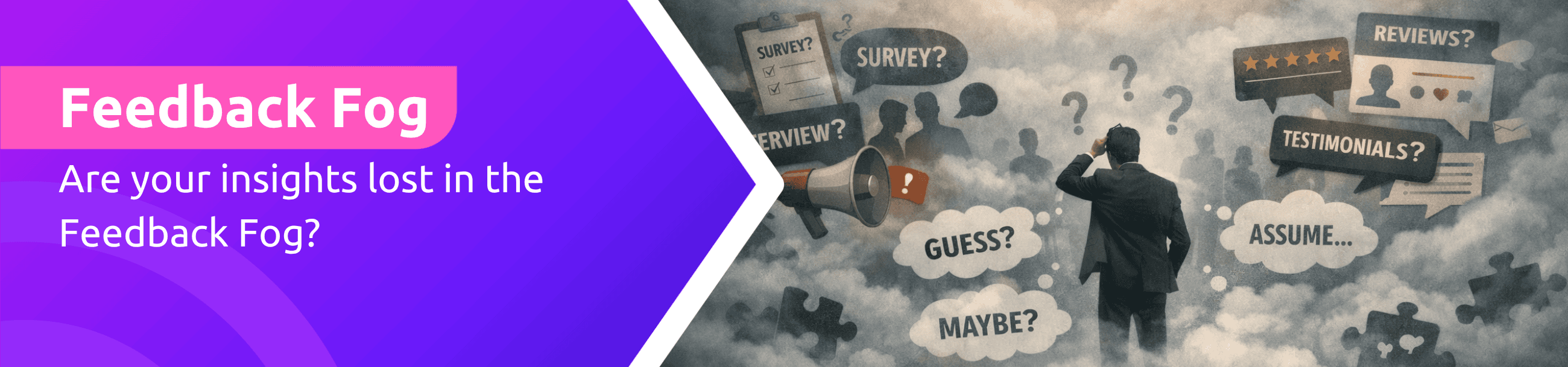
Feedback Fog is the confusion, distortion and delay that occur when client feedback is fragmented, selective and disconnected from decision-making.
It doesn't mean you're not collecting feedback. Most firms are sending surveys, interviewing clients and tracking scores.
But activity isn't the same as clarity.
Feedback Fog happens when feedback exists, but shared understanding doesn’t. It's the gap between collecting information and actually knowing what your clients think, feel and intend.
Imagine driving on a foggy day. Shapes are visible, but the direction is hazy. You make decisions cautiously, because you're not sure what's ahead.
Feedback Fog rarely comes from a lack of effort. It comes from how traditional client listening programmes are structured.
In most professional and business services firms, a combination of familiar habits are creating foggy conditions:
Individually, each of these feels manageable. Together, they create low visibility and uncertainty.
Just as spreadsheets once limited financial visibility, fragmented feedback limits client visibility. And uncertainty shapes behaviour in ways that compound the problem.
Here's where Feedback Fog gets cultural rather than just operational.
In many firms, the relationship lead decides if and when it feels like the "right time" to request client feedback.
The intention is understandable. No one wants unnecessary risk or an uncomfortable surprise from a relationship they're confident about. No one wants contradictory evidence disrupting a deal in progress.
But when feedback is only requested at safe moments, something subtle happens: evidence starts to align conveniently with existing assumptions.
Contradictory insights get avoided rather than surfaced. Feedback becomes filtered. Visibility narrows instead of expanding.
When insight is sporadic and siloed, feedback feels personal and risky.
If contradictory information appears unexpectedly, it can feel like an individual challenge rather than an opportunity for collective learning. The safest response is to avoid that happening.
Fragmented visibility leads to selective listening.
Selective listening reinforces fragmented visibility.
Uncertainty grows. Feedback Fog deepens.
The problem is, the wrong risk is being mitigated. The risk of individual surprises is seen as bigger than the risk of collective surprises.
One of the clearest illustrations of Feedback Fog is how firms respond to NPS scores that feel underwhelming.
When a client gives a 7 or an 8 the response is rationalisation rather than curiosity:
"They love us, they probably don't understand the scoring system."
"They always score conservatively."
"They said the advice was very helpful, what more do they want?"
Do these sound familiar? The number gets explained away rather than explored.
In reality, passive (a 7 or 8) rarely means neutral.
It often signals that the firm is delivering competently, but something is missing. Scope is being met, promises are being kept, but perhaps another adviser is doing something differently.
Perhaps expectations are evolving, or the relationship has quietly plateaued. The score isn't a criticism. It's a signal.
In Feedback Fog, numbers get defended. In strong Client Signal environments, numbers get decoded.
Professional services firms thrive on strong client relationships, early visibility of risk, and the ability to anticipate emerging client needs before a competitor does.
Feedback Fog undermines all three.
Instead of spotting demand early, firms respond to formal tenders. Instead of detecting dissatisfaction before it becomes a loss, they manage escalations. Instead of shaping services around evidence, they rely on assumption and gut feel.
Feedback Fog doesn't just hide risk.
It increases the cost of uncovering it—because the longer it goes unaddressed, the more it shapes culture, decisions and direction.
Organic growth requires clarity. Feedback Fog steadily reduces it.
Traditional client listening and mature Client Signal represent two fundamentally different operating systems.
The structural shift is to stop thinking in terms of client listening projects and even client listening programmes.
Rightly or wrongly, ‘client listening’ is seen by senior leadership as an optional series of projects that provide periodic results and individual insights. So the business case for doing 'more client listening' has been hard to make.
The alternative is to develop the maturity of your Client Signal. This means beginning with the end in mind, and working backwards from the commercial impact your insights can make.
Client listening tends to be small and discretionary; it leads to projects that are fragmented, delayed and selective.
Client Signal aligns with strategic goals because it's generating insights that are connected, continuous and widely accessible.
Client listening blurs the line between perception and proof.
Client Signal makes evidence visible to everyone—not just the partner closest to the relationship.
Client Signal is a strategic capability, used across the firm.
Firms with a strong Client Signal have a continuous flow of client-centred evidence that decision-makers across the firm can use to drive growth.
Marketing can see how the firm is currently positioned in the minds of clients and prospects.
BD and pursuits teams can respond the emerging sector and market needs before competitors notice them
Operations and complaints teams can discover the root-causes of complaints and discount requests, and take action to prevent recurrences.
Relationship leads and client teams can see how client expectations vary across stakeholders and engagements, to ensure they deliver work with real impact.
This strategic shift happens when firms:
When signals are connected and shared continuously, the fog lifts. Leaders stop debating what clients think and start responding to what clients actually need.
Here’s a few questions worth reflecting on:
If any of these feel uncomfortable, it’s likely your firm has Feedback Fog. It’s not because your firm doesn't care. It’s that your client listening programme is running a popular but outdated playbook.
The good news is that Jennie and Paul explore Feedback Fog—and the path through it—in much more depth in our upcoming book, Listen Differently. It will be available to pre-order in April, so if this resonates, watch this space.