
You’d be hard pushed to find a firm that doesn’t say they value client feedback. After all, growth hinges on strong relationships, which are based on trust and communication.
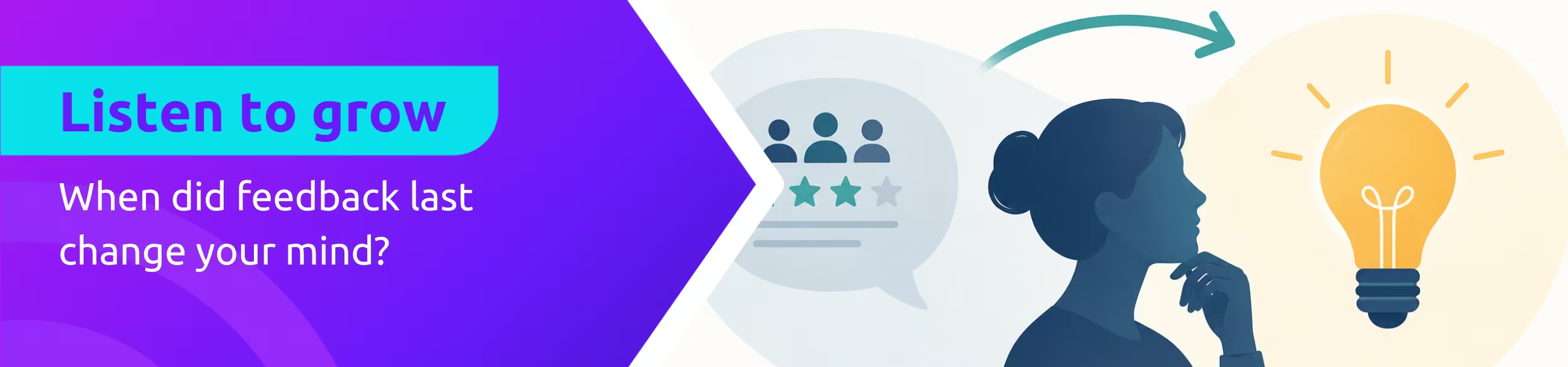
The more interesting question for prospects to ask is: when did a piece of client feedback last genuinely change a partner’s mind? Not confirm what they already believed. Change it.
For most firms, the honest answer is not recently. That’s not because clients have stopped talking. It’s because most listening programmes have quietly drifted into listening to measure.
As we highlighted in our book, listening to measure feels productive. Summary reports provide a score and a trend line, while leaving room for leaders to interpret them. Charts are defensible and easy to report upwards.
The problem is what that reporting does to decision-making. Without a culture of curiosity, it’s human nature to avoid being the messenger of bad news.
A report built around scores and soundbites tends to describe what has worked in the past, not what needs to change for the future. It tells partners they are doing fine, because the numbers are stable and the summaries are warm.
In reality, they’re lost in the Feedback Fog. Without specific evidence about what’s driving those scores, and what’s likely shaping future scores, the conversation quickly moves on. Over time the clients do too.
The alternative is not more data. It’s different stories, told more deliberately.
Growth and status quo are usually opposite sides of the coin. As the famous saying goes, ‘Insanity is doing the same thing over and over again and expecting different results.’
Growth requires change, and therefore hinges on curiosity rather than defensiveness.
Firms that listen to grow treat each reporting cycle as a chance to spark curiosity and leverage the expertise of their colleagues. Instead of the same summary slide every month, they highlight a different aspect of the client experience each time. Onboarding one month, project management the next, how a client's needs are shifting the month after that.
The stories that land are rarely AI-generated summaries.
They are grounded in the firm’s shared Client Signal. They lead with verbatim client comments, tied to firm-specific processes and touchpoints, surfacing a trend before it becomes obvious to everyone.
When a partner discovers that their client felt overlooked during a handover, or noticed a competitor doing something differently, they will instantly see the impact on their relationship and future revenue. They will want to act on the insights.
More broadly, partners with similar clients are moved to review or adapt their own delivery to avoid similar feedback and relationship risk. But they can only do this if the feedback is heard and the insights are shared.
Listening to grow requires deliberately shifting what insight reporting is for. Its job is not to prove the firm is doing well. Its job is to make partners curious enough to ask a question they would not otherwise have asked.
That’s hard to do when your reporting relies on AI summaries from generic models. Those reports are easy to produce but also easy to ignore. In writing fast, clean summaries, CoPilot and co. lose (or hallucinate) the real voice of the client.
Reporting with impact requires multiple AI models working in harmony. They must be able to summarise while also providing direct traceability to the verbatim comments and then the wider feedback from that client.
That’s because the emotive case for change comes from raw data: a real client, a real moment, a real relationship that’s about to change.
If you’ve read this far, you’re probably wondering where to start. So here’s three practical changes that can help you spark curiosity and growth.
Pick one Value Driver, journey stage, or client segment to spotlight, rather than repeating the same all-encompassing summary. A narrower focus makes it easier to go deep, and depth is where the surprises live.
A short, named verbatim about a specific touchpoint carries more weight than a paragraph of general summary. Let the AI do the heavy lifting of finding the pattern, then let the client's own words make the case.
A trend that is three data points old and pointing somewhere new is more valuable to a growth conversation than a trend that has been stable, and stated, for two years.
Start asking the same question internally. Ask partners, account managers, and operations teams: when was the last time client feedback changed your mind? Then get specific details of what changed as a result.